LAB/ Software 02 · Figma instrument
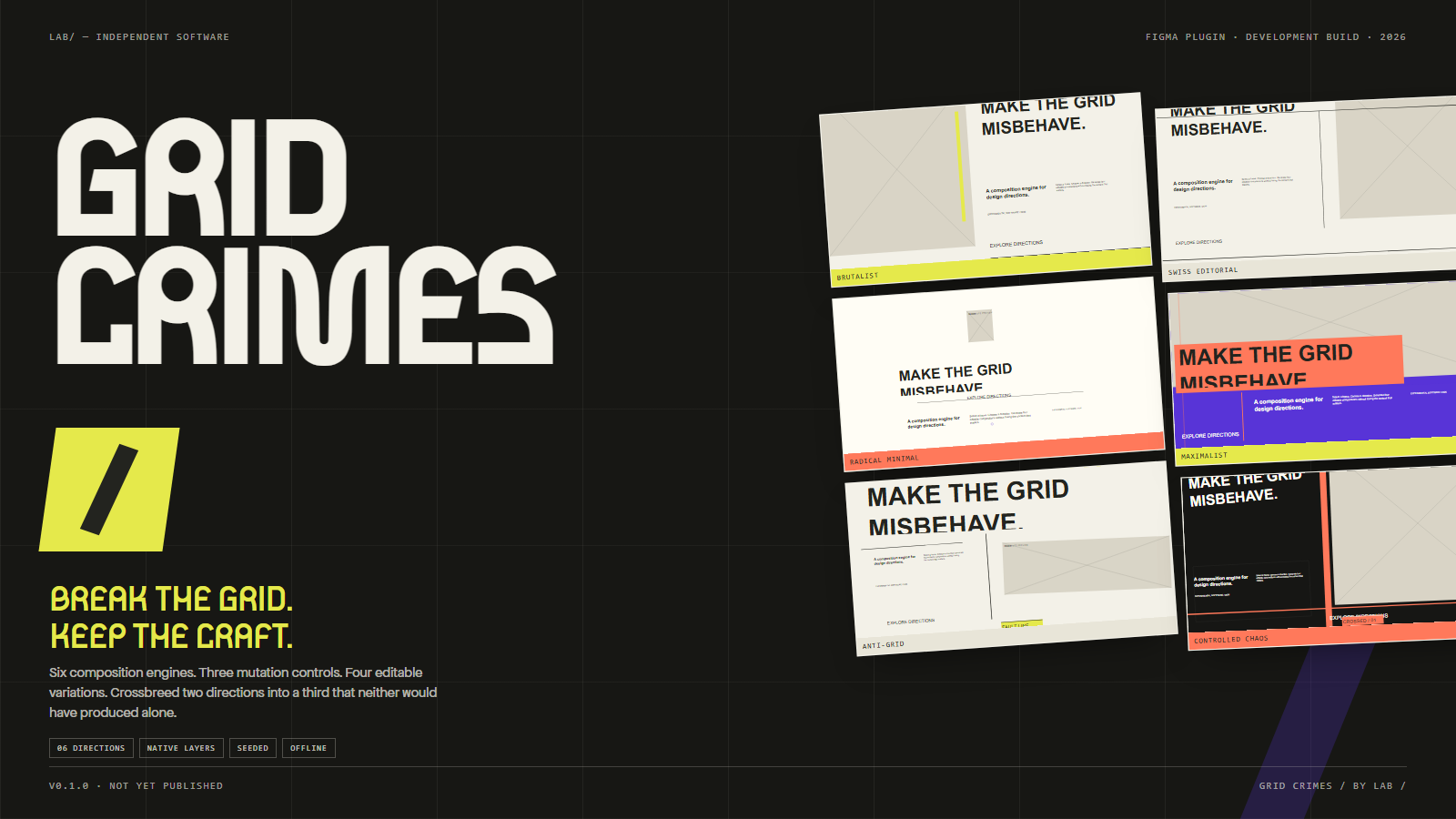
GridCrimes
Break the grid.
Keep the craft.
A procedural composition instrument for Figma. Select an existing composition, choose one of six art directions, and generate four new layouts that preserve the actual content as editable layers. Then crossbreed two directions into a third that neither would have produced alone.
- Platform
- Figma Design
- Engine
- Procedural, seeded
- Output
- Native layers
- Network
- None
Not a random layout generator.
Grid Crimes reads the selection as a composition: bounds, type sizes, text lengths, image fills, instances, auto-layout and layer names become a semantic block model. It infers roles, chooses a layout grammar, builds a plan, and scores the result before touching Figma.
Four variations come from four different grammars inside the chosen direction. Chaos controls deviation from alignment and scale order. Density controls space and compression. Hierarchy controls the distance between the focal point and its support. Seeds make the result reproducible.
The source is never edited. Every variation is its own frame, built by cloning the original layers, then repositioning and resizing them. Text stays text, images keep their fills, instances stay instances, and the whole batch is one native Figma undo away.
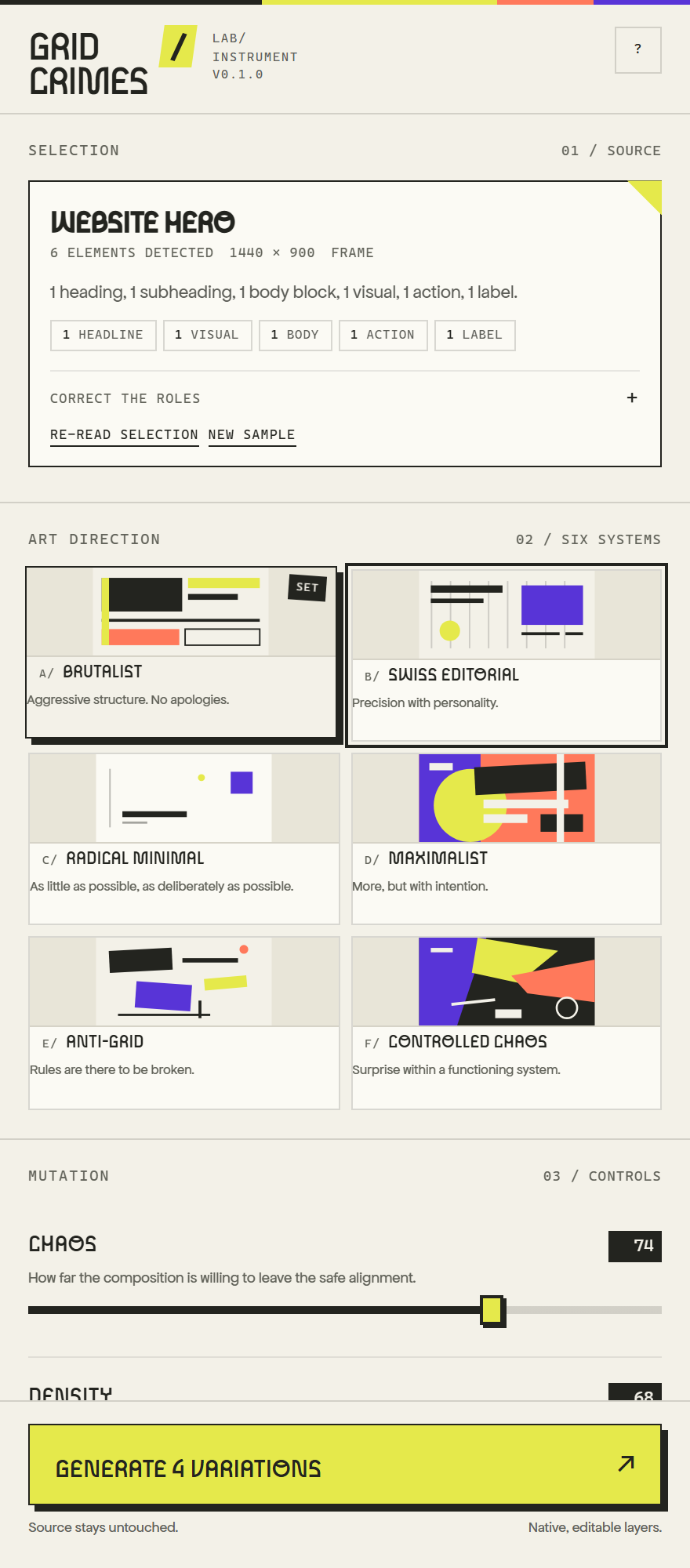
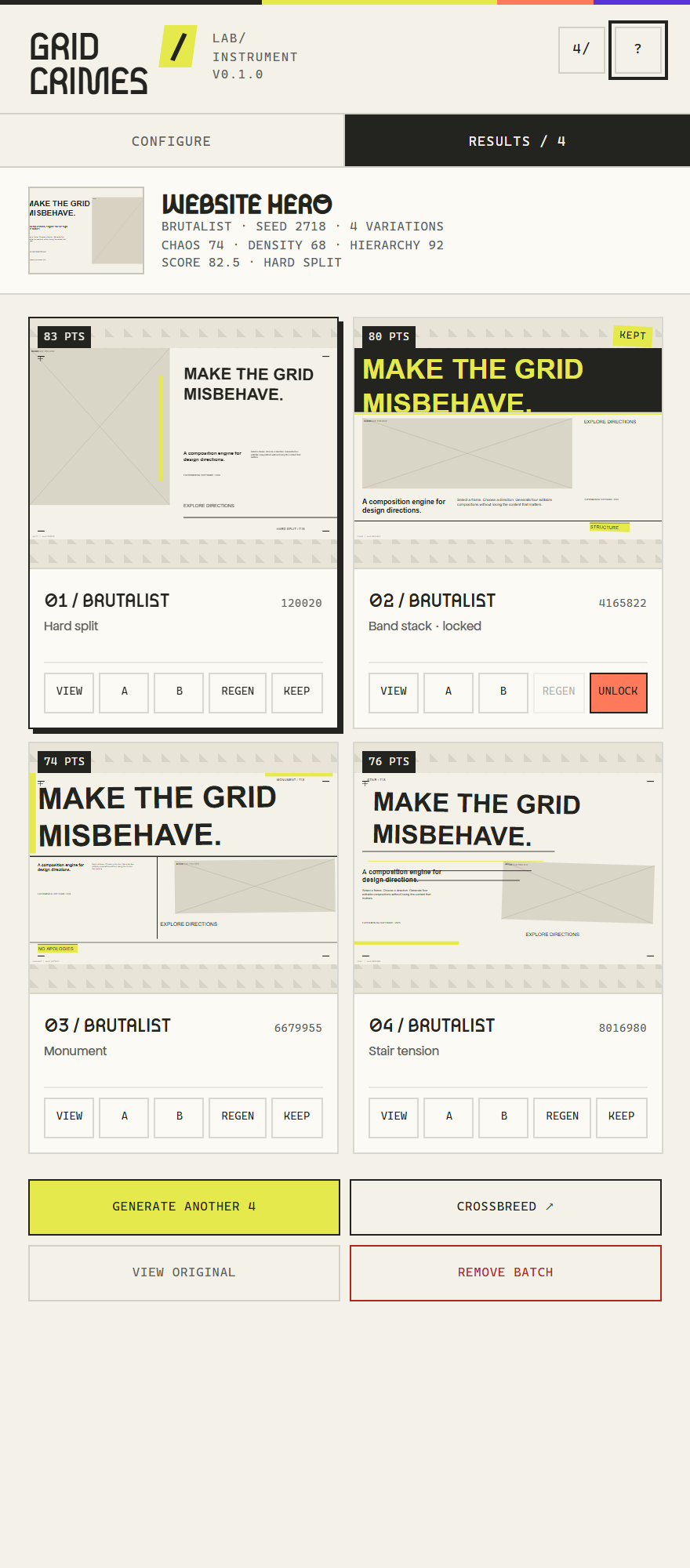
These are browser-rendered captures of the built interface and the real layout plans it produces. Native Figma frame QA is listed as pending below until the developer build has been loaded and tested inside Figma.
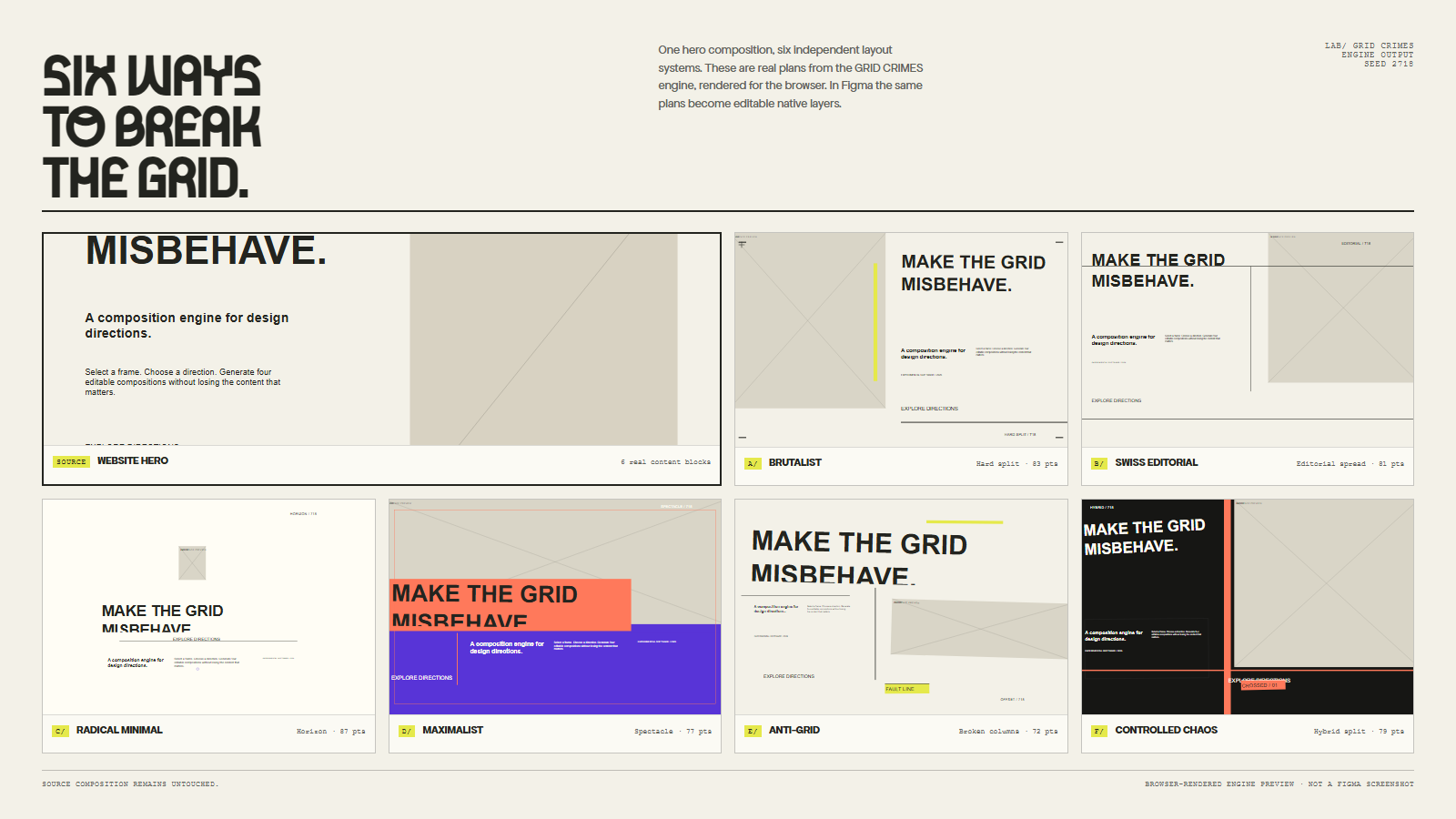
Six different creative directors.
Each direction owns its own composition grammars, spatial constraints, hierarchy relationships, colour strategy and preferred arrangements. The presets are not six palettes applied to one layout.
Brutalist
Monumental type, hard divisions and awkward, deliberate pressure. No apologies.
Swiss Editorial
A disciplined asymmetric column grid, editorial scale shifts and precise white space.
Radical Minimal
Negative space as the primary material. One decisive focal point, quiet support.
Maximalist
Layered colour, compressed rhythm and a loud but legible focal hierarchy.
Anti-grid
Coherent offsets, broken columns and tension produced by a system, not a dice roll.
Controlled Chaos
Hybrid grammars and spatial fractures that still pass containment and readability checks.
Two directions enter. A third leaves.
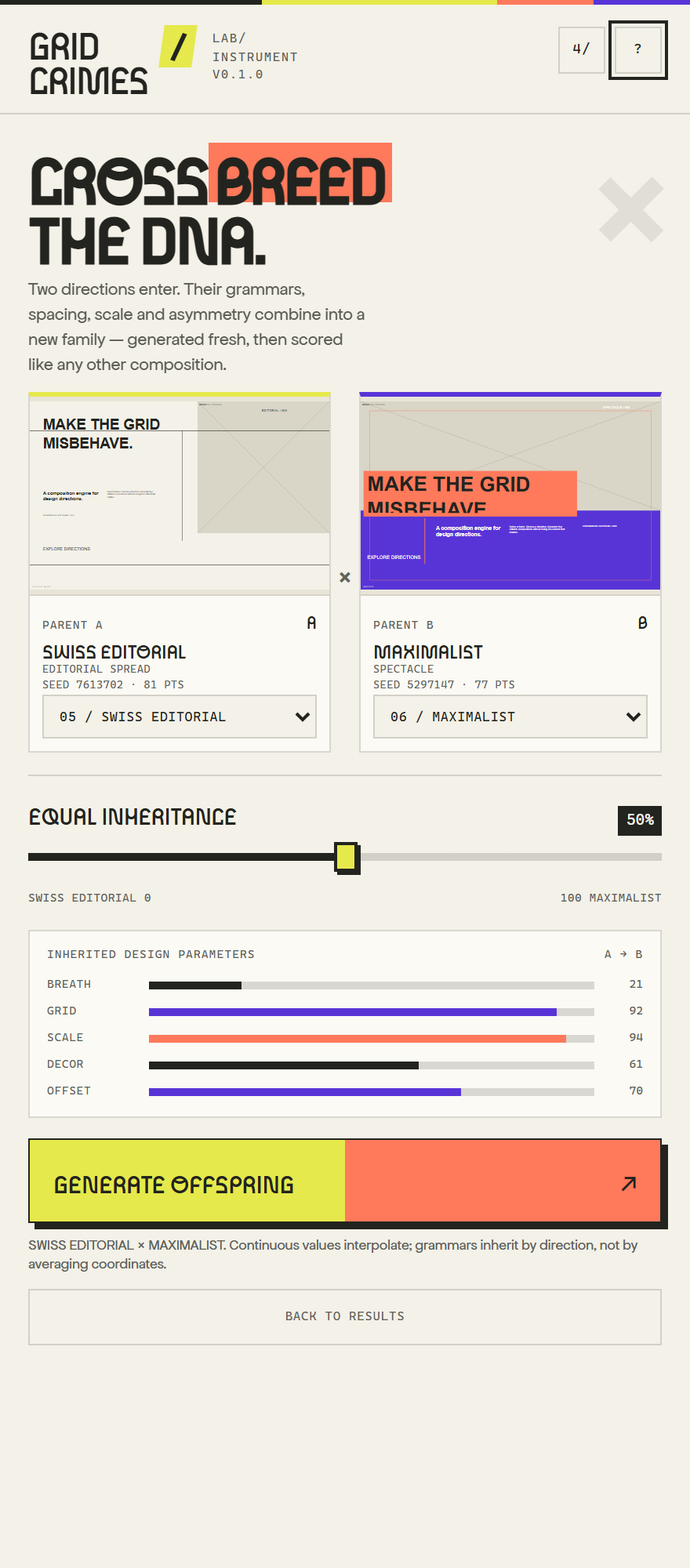
Crossbreed is not a coordinate average. Each variation stores its preset, seed, grammar and a small design DNA: margin, columns, asymmetry, rotation limit, scale contrast, decorative density, occupancy and alignment strategy.
The inheritance slider mixes those values, chooses grammars by direction, then generates a fresh family through the normal planning and quality-scoring pipeline. The midpoint is a real hybrid, not a compromise rectangle.
Real behaviour: parent DNA and batch metadata are stored on generated frames. Reopen the plugin, select two compatible variations, and the instrument can crossbreed them again. Incompatible sources are explained, never silently merged.
It runs locally. No Figma Community listing yet.
- Build the plugin. From the repository root, install the isolated workspace and run the build.
- Import the manifest. In the Figma desktop app, open Plugins → Development → Import plugin from manifest… and choose
plugins/grid-crimes/manifest.json. - Run Grid Crimes. Select a frame, group or a few sibling layers, or press Try with sample to create an editable demonstration.
- Generate. Pick a direction, adjust the three controls, then press Generate 4 variations. The batch appears beside the source in a 2×2 grid.
The manifest intentionally has no plugin ID. Figma assigns a local development identity on import. If your Figma build requires an explicit ID, create one blank development plugin, copy its generated ID into this manifest, and keep it local. A real published ID is added only through Figma's Community registration flow.
cd plugins/grid-crimes
pnpm install
pnpm run build- TypeScript / esbuildPassing
- Engine + adapter tests35 passing
- Browser UI QA9 / 9 cases
- Native Figma manual QAPending
- Community publicationNot submitted
pnpm run typecheck
pnpm run test
pnpm run qa
The Figma-specific acceptance checklist is in the plugin README. It covers layered text, mixed fonts, image crops, instances, auto-layout modules, locked layers, batch cleanup and repeated generation.
A real build, labelled honestly.
v0.1.0 · Figma Plugin
Six direction engines and 24 layout grammars. Seeded planning with constraint scoring. Chaos, density and hierarchy controls. Four native editable variations per batch. Source role detection and correction. Crossbreed with real DNA inheritance. Versioned plugin metadata. Missing-font and dense composition handling. Dense sources switch to an editorial index layout. Local build, tests and browser QA.
Before any Community submission
Native Figma verification on real documents, stress testing with large mixed-font files, final Community listing copy, support URL and privacy review. Publication requires the owner's explicit approval.
Break the grid.
Keep the craft.
The browser composition study is open now. The Figma build is ready for local development testing; publication is the next deliberate step.